
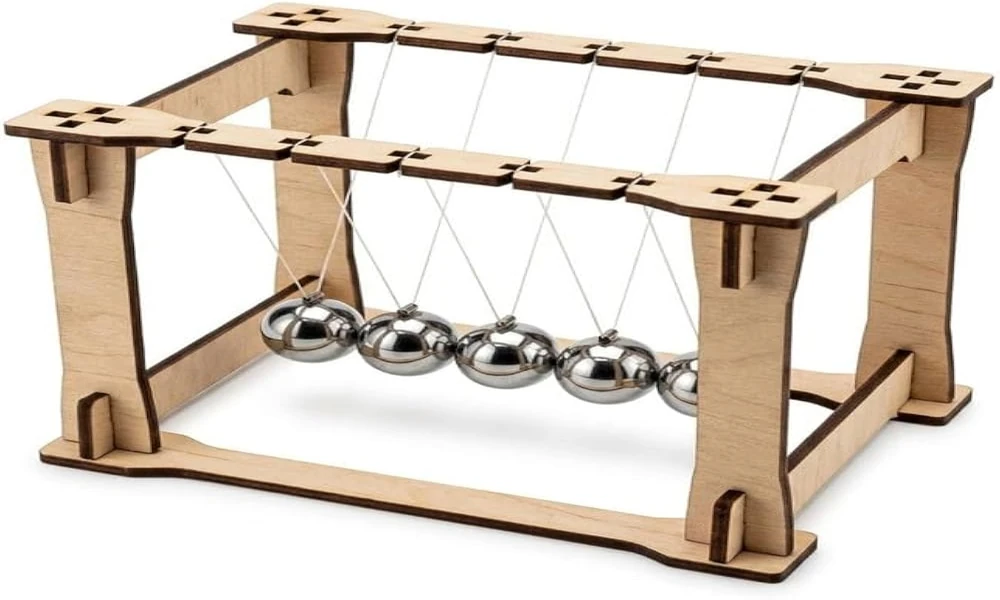
For undergraduate physics and mechanical engineering students, the Newton’s Cradle Pendulum simulator offers a dynamic platform to examine wave propagation, restitution, and energy dissipation. Learners can test discrete binary collision states ranging from single-sphere impulses to multi-sphere wave transfers, while monitoring live telemetry for momentum and kinetic energy conservation. By toggling between independent or combined conservation views, students can clearly separate momentum transfer from kinetic energy constraints during near-elastic steel impacts. Newton’s cradle simulator is particularly useful for visual learning because it turns otherwise difficult-to-picture physical interactions into a clear sequence of movement. Concepts such as force, momentum and energy transfer may seem abstract when students first encounter them in textbooks. The suspended steel balls give those concepts a tangible setting: learners can watch one ball move inward, hear a collision and see a ball at the far end swing away.
The most important educational benefit is the opportunity to connect observation with explanation. The central spheres may appear to stay still, but that does not mean nothing happens to them. During impact, they transmit forces and undergo extremely small deformations. This contrast between what is immediately visible and what physics predicts gives teachers a useful opening to discuss scientific models, measurement limits and hidden processes.
The apparatus also supports different ways of learning. Students can observe repeated demonstrations, manipulate the release height themselves, sketch the direction of movement or use slow-motion footage to inspect individual collisions. Educators can ask learners to describe what they see before introducing terms such as gravitational potential energy, kinetic energy, impulse and conservation of momentum. The progression from everyday language to precise scientific terminology can strengthen understanding.
A further lesson emerges as the oscillations gradually weaken. The decreasing swing amplitude leads naturally to questions about sound, friction, air resistance and energy dissipation. Because the system is familiar and easy to operate, students can repeat their observations instead of relying on a single demonstration. Students can even compare their initial description of the experiment with a revised explanation after learning the relevant conservation laws. The Newton’s cradle therefore combines visual appeal with opportunities for careful scientific reasoning, making it a memorable learning aid for a wide range of ages and abilities.
The simulator also serves as a practical bridge between classical mechanics and emerging contactless technologies. Students can contrast frictionless Simple Harmonic Motion against damped mechanical decay to observe how entropic losses through sound and heat degrade system efficiency, or trigger the Paradox state to visualise boundary conditions where kinetic energy conservation breaks down. Learners can even switch directly to the Active Magnetic Cradle mode to compare traditional impact mechanics with contactless magnetic dipole repulsion.
Newton’s Cradle Simulator
Compare classical mechanical sphere impacts with parallel-face Active Magnetic Cradle (AMC) dipole carriages.
|
Impacts: 0 | Energy Retained: 100.0%